01 / The Beginning
Rainforest
The trek begins in humid montane forest, with tall trees, ferns and moss, and mist often hanging between the trunks.

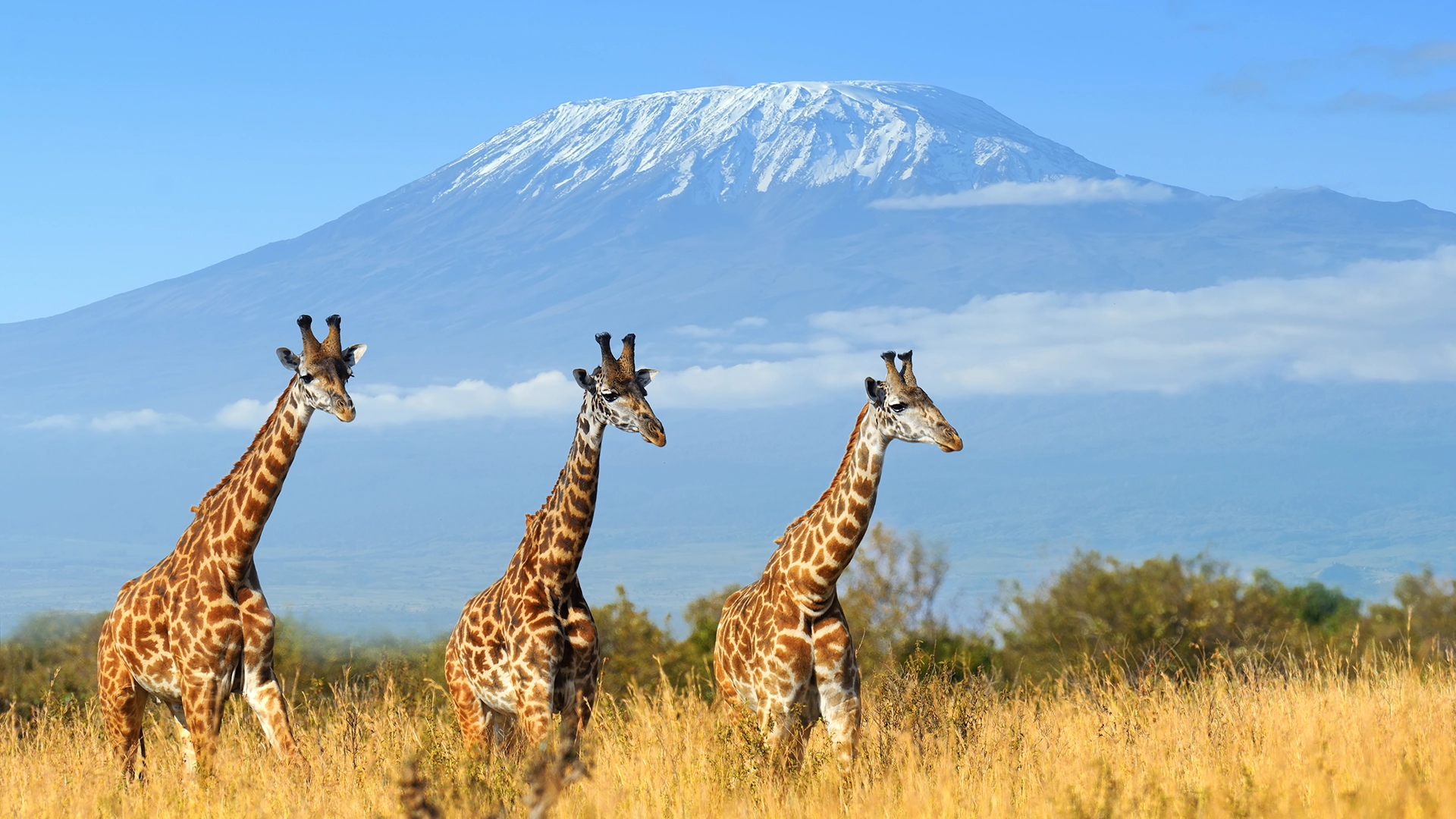
Kilimanjaro Adventures
Trek through rainforest, moorland and alpine desert towards Uhuru Peak, the highest point in Africa.
The Mountain
Kilimanjaro is a high-altitude trek rather than a technical climb. Over several days you pass through distinct ecological zones, from rainforest to the glaciers near Uhuru Peak at 5,895 m. Altitude is the real challenge, so route choice, a gradual pace and good physical preparation all shape the experience.
01 / The Beginning
The trek begins in humid montane forest, with tall trees, ferns and moss, and mist often hanging between the trunks.
02 / The Landscape
Above the forest, giant heather and open moorland widen the views, and the summit cone comes into sight.

03 / The High Mountain
Higher still, plants thin out to a stony alpine desert: bright, dry days, cold nights and a slow, steady rhythm.

04 / The Summit
A night ascent leads to the crater rim and on to Uhuru Peak among glaciers and ice fields, followed by a long descent to lower camps.
Plan Your Climb
Choosing how to climb Kilimanjaro comes down to the time you have, the pace that suits you and the kind of trek you want.
More days on the mountain mean more time to acclimatise. Itineraries range from five to nine days, depending on the route.
Kilimanjaro is walked slowly and steadily, pole pole. A route that matches your fitness and trekking experience makes each day more enjoyable.
We help you compare routes, fit the climb around the rest of your travels and understand the practical preparation before you go.
Kilimanjaro Routes
Six established routes lead to Uhuru Peak, each with its own approach, landscapes and pace. Below are the itineraries we most often plan on each one, from the shorter option to the more gradual.
Route length matters at altitude. Longer itineraries allow more time for gradual acclimatisation, while weather, individual response to altitude and mountain conditions always vary.
Kilimanjaro climbs from US$2,100 per climber. Prices are indicative starting rates in USD per climber, based on two climbers travelling together. Final pricing depends on route, dates, group size and final trip arrangements. Your written quotation confirms the final price and inclusions. A longer itinerary costs more because of the extra day on the mountain, not because it guarantees the summit.
01 / 06
Scenic western approach
Lemosho begins in the forests on Kilimanjaro’s western side and crosses the broad Shira Plateau before joining the southern trails beneath the glaciers. Its gradual start and longer profile make it one of the most rewarding ways onto the mountain.
7 Days
Western approach · Camping · Shira Plateau
From US$2,450 per climber
Londorossi Gate → Mti Mkubwa Camp
After registering at Londorossi Gate, drive on to the Lemosho trailhead and walk into quiet montane forest to the first camp, set among large old trees.
Rainforest
Mti Mkubwa → Shira 2 Camp
Leave the forest for giant heather and open moorland, climb onto the Shira Plateau and cross it past Shira 1 to camp with wide views of Kibo.
Heath & moorland
Shira 2 → Lava Tower → Barranco Camp
Climb steadily to the Lava Tower, then descend into the Barranco Valley among giant groundsels. Climbing high and sleeping lower is part of the acclimatisation pattern.
Alpine desert
Barranco → Karanga Camp
Begin with the Barranco Wall, a steep scramble that is more hands-on than technical, then follow a rolling path across valleys to Karanga.
Alpine desert
Karanga → Barafu Camp
A short climb onto barren, rocky ground to the high camp. The afternoon is for rest, an early meal and preparation for the summit night.
Alpine desert
Barafu → Uhuru Peak → Mweka Camp
Set out around midnight, reaching Stella Point on the crater rim near dawn and continuing to Uhuru Peak, 5,895 m. A long descent follows, back past Barafu to Mweka Camp.
Summit
Mweka Camp → Mweka Gate
Walk down through the rainforest to Mweka Gate to sign out of the national park, then transfer back.
Rainforest
8 Days
Western approach · Camping · Two nights on the Shira Plateau
From US$2,650 per climber
More time to acclimatise
Londorossi Gate → Mti Mkubwa Camp
After registering at Londorossi Gate, drive on to the Lemosho trailhead and walk into quiet montane forest to the first camp, set among large old trees.
Rainforest
Mti Mkubwa → Shira 1 Camp
Climb out of the forest through heather and moorland to the western edge of the Shira Plateau, with the summit cone in view for the first time.
Heath & moorland
Shira 1 → Shira 2 Camp
A gentler day across the open plateau, with time to adjust to the altitude and look across to Kibo’s western glaciers.
Heath & moorland
Shira 2 → Lava Tower → Barranco Camp
Climb steadily to the Lava Tower, then descend into the Barranco Valley among giant groundsels. Climbing high and sleeping lower is part of the acclimatisation pattern.
Alpine desert
Barranco → Karanga Camp
Begin with the Barranco Wall, a steep scramble that is more hands-on than technical, then follow a rolling path across valleys to Karanga.
Alpine desert
Karanga → Barafu Camp
A short climb onto barren, rocky ground to the high camp. The afternoon is for rest, an early meal and preparation for the summit night.
Alpine desert
Barafu → Uhuru Peak → Mweka Camp
Set out around midnight, reaching Stella Point on the crater rim near dawn and continuing to Uhuru Peak, 5,895 m. A long descent follows, back past Barafu to Mweka Camp.
Summit
Mweka Camp → Mweka Gate
Walk down through the rainforest to Mweka Gate to sign out of the national park, then transfer back.
Rainforest
02 / 06
Popular southern approach
The “Whiskey Route”
Machame climbs from the southern forests through each of Kilimanjaro’s vegetation zones and meets the Lemosho trail at Lava Tower and Barranco. Varied scenery and the Barranco Wall make it one of the mountain’s best-known routes, with a steeper start than Lemosho.
6 Days
Southern approach · Camping · Barranco Wall
From US$2,250 per climber
Machame Gate → Machame Camp
From the gate on the southern slopes, a steady climb through dense rainforest brings you to the first camp near the forest edge.
Rainforest
Machame Camp → Shira 2 Camp
Leave the forest for heath and moorland, climbing a rocky ridge onto the Shira Plateau with open views to the west.
Heath & moorland
Shira 2 → Lava Tower → Barranco Camp
Climb steadily to the Lava Tower, then descend into the Barranco Valley among giant groundsels. Climbing high and sleeping lower is part of the acclimatisation pattern.
Alpine desert
Barranco → Karanga → Barafu Camp
The Barranco Wall, a break around Karanga, then on to the high camp at Barafu. Joining two stages here is where the shorter itinerary gives up acclimatisation time.
Alpine desert
Barafu → Uhuru Peak → Mweka Camp
Set out around midnight, reaching Stella Point on the crater rim near dawn and continuing to Uhuru Peak, 5,895 m. A long descent follows, back past Barafu to Mweka Camp.
Summit
Mweka Camp → Mweka Gate
Walk down through the rainforest to Mweka Gate to sign out of the national park, then transfer back.
Rainforest
7 Days
Southern approach · Camping · Night at Karanga
From US$2,450 per climber
More gradual option
Machame Gate → Machame Camp
From the gate on the southern slopes, a steady climb through dense rainforest brings you to the first camp near the forest edge.
Rainforest
Machame Camp → Shira 2 Camp
Leave the forest for heath and moorland, climbing a rocky ridge onto the Shira Plateau with open views to the west.
Heath & moorland
Shira 2 → Lava Tower → Barranco Camp
Climb steadily to the Lava Tower, then descend into the Barranco Valley among giant groundsels. Climbing high and sleeping lower is part of the acclimatisation pattern.
Alpine desert
Barranco → Karanga Camp
Begin with the Barranco Wall, a steep scramble that is more hands-on than technical, then follow a rolling path across valleys to Karanga.
Alpine desert
Karanga → Barafu Camp
A short climb onto barren, rocky ground to the high camp. The afternoon is for rest, an early meal and preparation for the summit night.
Alpine desert
Barafu → Uhuru Peak → Mweka Camp
Set out around midnight, reaching Stella Point on the crater rim near dawn and continuing to Uhuru Peak, 5,895 m. A long descent follows, back past Barafu to Mweka Camp.
Summit
Mweka Camp → Mweka Gate
Walk down through the rainforest to Mweka Gate to sign out of the national park, then transfer back.
Rainforest
03 / 06
Hut-based route
Marangu climbs from the southeast and is the only major Kilimanjaro route with dormitory-style mountain huts rather than tents. The trail is steady and well defined, but it gains altitude quickly, so the summit remains a serious undertaking.
5 Days
Southeastern approach · Huts · Same trail up and down
From US$2,100 per climber
Marangu Gate → Mandara Hut
A steady walk through the rainforest to the first huts. A short detour to the Maundi Crater rim is often possible in the afternoon.
Rainforest
Mandara Hut → Horombo Hut
Out of the forest and into open heath and moorland, with Kibo and the jagged peaks of Mawenzi ahead.
Heath & moorland
Horombo Hut → Kibo Hut
Cross the Saddle, a wide stretch of alpine desert between Mawenzi and Kibo, to the hut at the foot of the summit cone.
Alpine desert
Kibo Hut → Uhuru Peak → Horombo Hut
Leave around midnight and climb the steep scree to Gilman’s Point on the crater rim, then follow the rim to Uhuru Peak, 5,895 m. A long descent follows to Horombo.
Summit
Horombo Hut → Marangu Gate
Descend through moorland and rainforest to Marangu Gate to sign out, then transfer back.
Rainforest
6 Days
Southeastern approach · Huts · Extra night at Horombo
From US$2,300 per climber
More time to acclimatise
Marangu Gate → Mandara Hut
A steady walk through the rainforest to the first huts. A short detour to the Maundi Crater rim is often possible in the afternoon.
Rainforest
Mandara Hut → Horombo Hut
Out of the forest and into open heath and moorland, with Kibo and the jagged peaks of Mawenzi ahead.
Heath & moorland
Acclimatisation day at Horombo
A second night at Horombo, with a walk higher towards Zebra Rocks or the Mawenzi side and back, gives the body more time to adjust.
Heath & moorland
Horombo Hut → Kibo Hut
Cross the Saddle, a wide stretch of alpine desert between Mawenzi and Kibo, to the hut at the foot of the summit cone.
Alpine desert
Kibo Hut → Uhuru Peak → Horombo Hut
Leave around midnight and climb the steep scree to Gilman’s Point on the crater rim, then follow the rim to Uhuru Peak, 5,895 m. A long descent follows to Horombo.
Summit
Horombo Hut → Marangu Gate
Descend through moorland and rainforest to Marangu Gate to sign out, then transfer back.
Rainforest
04 / 06
Quieter northern approach
Rongai starts near the Kenyan border on Kilimanjaro’s drier northern side, where the trail is usually quieter. It climbs past the jagged peaks of Mawenzi to Kibo Hut and descends on the southeast by the Marangu route, so you see both sides of the mountain.
6 Days
Northern approach · Camping · Descent via Marangu
From US$2,350 per climber
Rongai Gate → Simba Camp
Drive round to the northern side of the mountain and set off from the Rongai (Nalemoru) gate through farmland and forest edge to Simba Camp.
Rainforest
Simba Camp → Kikelewa Camp
A longer day across the northern moorland, passing Second Cave, then turning towards Mawenzi to camp at Kikelewa.
Heath & moorland
Kikelewa → Mawenzi Tarn Camp
A short, steep climb to a camp beside a small tarn in a sheltered bowl beneath Mawenzi’s spires.
Alpine desert
Mawenzi Tarn → Kibo Hut
Cross the Saddle, the open alpine desert between Mawenzi and Kibo, to the high camp at the foot of the summit cone.
Alpine desert
Kibo Hut → Uhuru Peak → Horombo Hut
Leave around midnight and climb the steep scree to Gilman’s Point on the crater rim, then follow the rim to Uhuru Peak, 5,895 m. A long descent follows to Horombo.
Summit
Horombo Hut → Marangu Gate
Descend through moorland and rainforest to Marangu Gate to sign out, then transfer back.
Rainforest
7 Days
Northern approach · Camping · Night at Second Cave
From US$2,550 per climber
More time to acclimatise
Rongai Gate → Simba Camp
Drive round to the northern side of the mountain and set off from the Rongai (Nalemoru) gate through farmland and forest edge to Simba Camp.
Rainforest
Simba Camp → Second Cave Camp
A shorter, steady climb across the open northern moorland, with Kibo growing larger ahead.
Heath & moorland
Second Cave → Kikelewa Camp
Leave the main trail and head east towards Mawenzi across heath and moorland to Kikelewa.
Heath & moorland
Kikelewa → Mawenzi Tarn Camp
A short, steep climb to a camp beside a small tarn in a sheltered bowl beneath Mawenzi’s spires.
Alpine desert
Mawenzi Tarn → Kibo Hut
Cross the Saddle, the open alpine desert between Mawenzi and Kibo, to the high camp at the foot of the summit cone.
Alpine desert
Kibo Hut → Uhuru Peak → Horombo Hut
Leave around midnight and climb the steep scree to Gilman’s Point on the crater rim, then follow the rim to Uhuru Peak, 5,895 m. A long descent follows to Horombo.
Summit
Horombo Hut → Marangu Gate
Descend through moorland and rainforest to Marangu Gate to sign out, then transfer back.
Rainforest
05 / 06
Longer northern traverse
The Northern Circuit follows the Lemosho approach across the Shira Plateau, then leaves the busier southern trails to traverse Kilimanjaro’s remote northern slopes before the summit. It is the longest route on the mountain, with a gradual profile and more days at altitude.
8 Days
Western approach · Northern traverse · Camping
From US$2,950 per climber
Longer, more gradual route
Londorossi Gate → Mti Mkubwa Camp
After registering at Londorossi Gate, drive on to the Lemosho trailhead and walk into quiet montane forest to the first camp, set among large old trees.
Rainforest
Mti Mkubwa → Shira 1 Camp
Climb out of the forest through heather and moorland to the western edge of the Shira Plateau, with the summit cone in view for the first time.
Heath & moorland
Shira 1 → Moir Hut
Cross the Shira Plateau towards the mountain’s northwestern side to camp at Moir Hut, beneath the Lent Hills.
Heath & moorland
Moir Hut → Buffalo Camp
Climb over the Lent Hills and begin the traverse of the northern slopes, looking out over the plains towards Kenya.
Alpine desert
Buffalo Camp → Third Cave Camp
Continue east around the quiet northern flanks, where few other trekkers are seen.
Heath & moorland
Third Cave → School Hut
Climb towards the Saddle to the high camp below the summit cone, resting and preparing for the night ahead.
Alpine desert
School Hut → Uhuru Peak → Mweka Camp
Leave around midnight for the crater rim and Uhuru Peak, 5,895 m, then descend on the southern side to camp on the Mweka route.
Summit
Mweka Camp → Mweka Gate
Walk down through the rainforest to Mweka Gate to sign out of the national park, then transfer back.
Rainforest
9 Days
Western approach · Northern traverse · Lava Tower
From US$3,150 per climber
More time to acclimatise
Londorossi Gate → Mti Mkubwa Camp
After registering at Londorossi Gate, drive on to the Lemosho trailhead and walk into quiet montane forest to the first camp, set among large old trees.
Rainforest
Mti Mkubwa → Shira 1 Camp
Climb out of the forest through heather and moorland to the western edge of the Shira Plateau, with the summit cone in view for the first time.
Heath & moorland
Shira 1 → Shira 2 Camp
A gentler day across the open plateau, with time to adjust to the altitude and look across to Kibo’s western glaciers.
Heath & moorland
Shira 2 → Lava Tower → Moir Hut
Climb to the Lava Tower for time at altitude, then turn north and descend to Moir Hut on the northwestern side.
Alpine desert
Moir Hut → Buffalo Camp
Climb over the Lent Hills and begin the traverse of the northern slopes, looking out over the plains towards Kenya.
Alpine desert
Buffalo Camp → Third Cave Camp
Continue east around the quiet northern flanks, where few other trekkers are seen.
Heath & moorland
Third Cave → School Hut
Climb towards the Saddle to the high camp below the summit cone, resting and preparing for the night ahead.
Alpine desert
School Hut → Uhuru Peak → Mweka Camp
Leave around midnight for the crater rim and Uhuru Peak, 5,895 m, then descend on the southern side to camp on the Mweka route.
Summit
Mweka Camp → Mweka Gate
Walk down through the rainforest to Mweka Gate to sign out of the national park, then transfer back.
Rainforest
06 / 06
Steep advanced approach
Advanced option
Umbwe is the shortest and steepest way up the southern side, following a narrow forest ridge to Barranco. Because it gains height very quickly, it suits experienced trekkers who already know how they respond to altitude, and it is rarely the right first choice.
6 Days
Direct southern approach · Camping · Rapid early ascent
From US$2,250 per climber
Umbwe Gate → Umbwe Camp
A steep, sustained climb along a narrow forested ridge, often using tree roots as steps, to a camp near Umbwe Cave.
Rainforest
Umbwe Camp → Barranco Camp
Continue up the ridge through heath, with the Western Breach above, to join the southern circuit at Barranco.
Heath & moorland
Barranco → Karanga Camp
Begin with the Barranco Wall, a steep scramble that is more hands-on than technical, then follow a rolling path across valleys to Karanga.
Alpine desert
Karanga → Barafu Camp
A short climb onto barren, rocky ground to the high camp. The afternoon is for rest, an early meal and preparation for the summit night.
Alpine desert
Barafu → Uhuru Peak → Mweka Camp
Set out around midnight, reaching Stella Point on the crater rim near dawn and continuing to Uhuru Peak, 5,895 m. A long descent follows, back past Barafu to Mweka Camp.
Summit
Mweka Camp → Mweka Gate
Walk down through the rainforest to Mweka Gate to sign out of the national park, then transfer back.
Rainforest
7 Days
Direct southern approach · Camping · Extra night at Barranco
From US$2,450 per climber
More time to acclimatise
Umbwe Gate → Umbwe Camp
A steep, sustained climb along a narrow forested ridge, often using tree roots as steps, to a camp near Umbwe Cave.
Rainforest
Umbwe Camp → Barranco Camp
Continue up the ridge through heath, with the Western Breach above, to join the southern circuit at Barranco.
Heath & moorland
Acclimatisation day at Barranco
A second night at Barranco, with a walk higher and back down, gives the body time to catch up after the rapid start.
Alpine desert
Barranco → Karanga Camp
Begin with the Barranco Wall, a steep scramble that is more hands-on than technical, then follow a rolling path across valleys to Karanga.
Alpine desert
Karanga → Barafu Camp
A short climb onto barren, rocky ground to the high camp. The afternoon is for rest, an early meal and preparation for the summit night.
Alpine desert
Barafu → Uhuru Peak → Mweka Camp
Set out around midnight, reaching Stella Point on the crater rim near dawn and continuing to Uhuru Peak, 5,895 m. A long descent follows, back past Barafu to Mweka Camp.
Summit
Mweka Camp → Mweka Gate
Walk down through the rainforest to Mweka Gate to sign out of the national park, then transfer back.
Rainforest
Tell us about your available time, trekking experience and travel plans, and we’ll help you compare the options.
Want more time at altitude first? The 4-Day Mount Meru Trek, from US$1,650 per climber, climbs Tanzania’s second-highest mountain and is a demanding trek in its own right.
Ready to Explore Tanzania?
From safari plains to Kilimanjaro and Zanzibar, let us help shape a journey made for you.